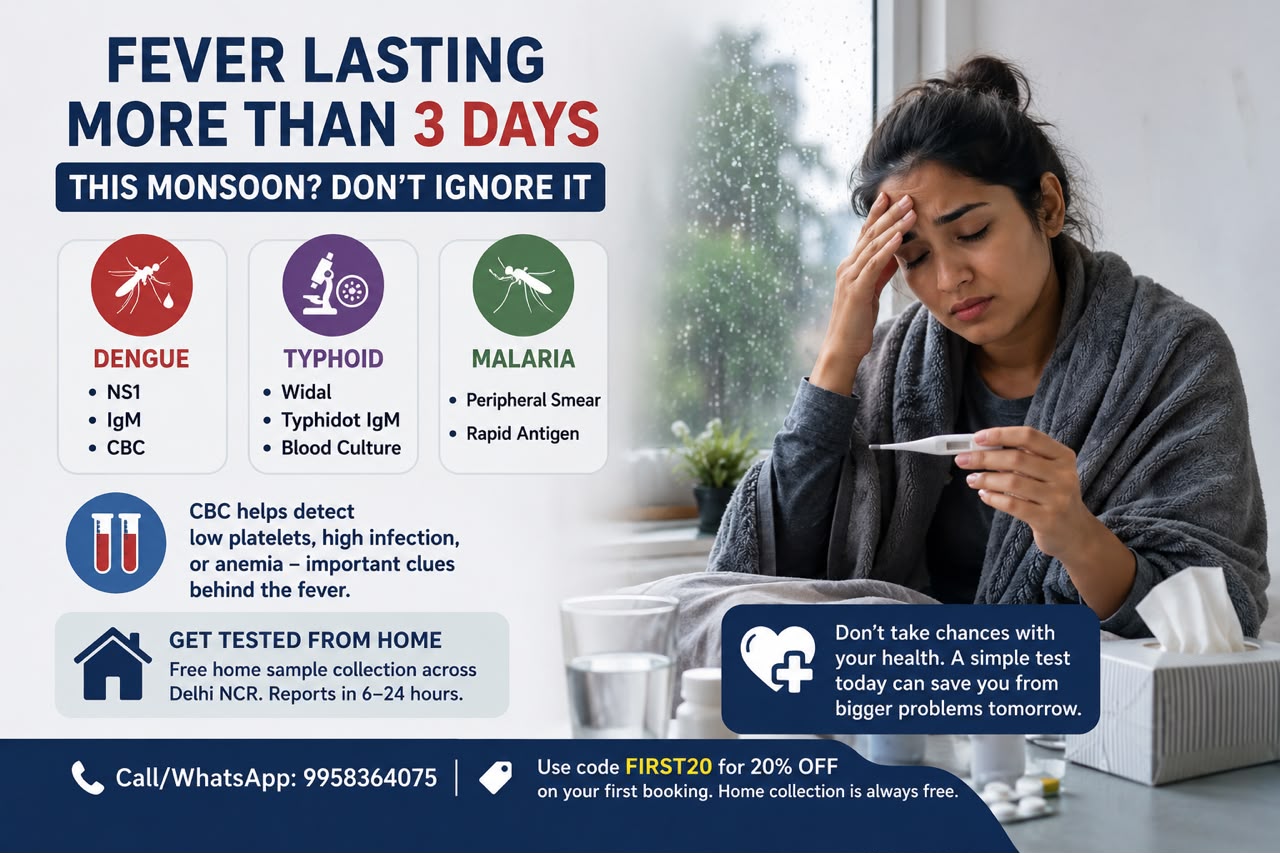
Fever Lasting More Than 3 Days This
Monsoon?
Don’t Ignore It.
If you live in Delhi NCR, you already know what monsoon means.
Rain, traffic, and suddenly everyone around you has a fever.
Most of the time it’s just a viral fever. 2-3 days of rest, paracetamol, lots of water, and you’re
back on your feet.
But what if the fever doesn’t go away?
What if day 4 comes and you’re still burning up, body aching, and too tired to even get up?
That’s when you shouldn’t wait.
Every year during monsoon, hospitals in Delhi, Noida, Gurgaon see a big jump in dengue,
typhoid, and malaria cases. The tricky part is, in the beginning all 3 feel almost the same.
High fever. Headache. Body pain. No appetite. Without a blood test, it’s really hard to tell
what’s going on inside.
When should you get tested?
Not every fever needs a lab visit. But talk to your doctor and get tested if:
● Your fever is above 101°F and has stayed for more than 3 days
● You have severe body pain or pain behind your eyes
● You get chills and then start sweating heavily
● You have stomach pain, vomiting, loose motions, or no appetite at all
● You notice bleeding from gums, nose, or tiny red spots on skin
These don’t automatically mean dengue or typhoid. They just mean your body needs to be
checked properly.
The 3 tests doctors usually ask for during monsoon
1. Dengue Test: NS1 + IgM + CBC
Dengue cases shoot up the moment it starts raining in Delhi NCR.
If you’ve had fever for 1-5 days, doctors usually check NS1. After that, they check IgM
antibodies.
A CBC is also done with it. Everyone talks about platelets, but doctors also look at WBC and
other counts to see how your body is responding.
At Lab N Med, CBC usually comes in 6 hours. Dengue NS1 and IgM reports come within 24
hours.
2. Typhoid Tests: Widal, Typhidot IgM, Blood Culture
Typhoid is sneaky. The fever builds up slowly and can stay high all day. Some people also
get stomach problems, constipation, or loose motions.
Depending on your symptoms, your doctor may ask for the following:
● Widal: Old test, gives quick results
● Typhidot IgM: Better for detecting active infection
● Blood Culture: Takes 3-5 days but it’s the most accurate because it finds the bacteria
directly
3. Malaria Tests: Peripheral Smear + Rapid Antigen
Malaria is not as common in urban Delhi as dengue, but it still happens, especially where
there’s waterlogging and mosquitoes.
Doctors usually do 2 tests together:
● Peripheral Smear: Lab tech checks your blood under a microscope to spot the
parasite
● Rapid Antigen Test: Faster result
Using both together gives a clearer answer.
So where does CBC fit in?
CBC can’t tell you “this is dengue” or “this is malaria." But it gives your doctor important
hints.
Low platelets often show up in dengue. High WBC can mean bacterial infection. Low
hemoglobin is sometimes seen in malaria.
That’s why CBC is usually the first test doctors recommend when fever won’t settle.
At Lab N Med, a CBC costs ₹280 instead of ₹350, and you get the report in about 6 hours.
Get tested from home with Lab N Med
Let’s be honest. When you have a fever, the last thing you want is to stand in a lab queue.
That’s why Lab N Med does free home sample collection across Delhi, Gurgaon and Noida
Here’s how it works:
1. Book your test.
2. A trained phlebotomist comes to your home.
3. Sample is taken safely and sent to an NABL-accredited lab.
4. Once verified by senior pathologists, your report lands on WhatsApp and email.
Most reports are ready in 6 to 24 hours.
Most fevers do get better in a few days. But if yours is crossing day 3, don’t brush it off as
“just viral”.
A simple blood test can tell your doctor if it’s dengue, typhoid, malaria, or something else.
And the sooner you know, the sooner you can start the right treatment.
If your doctor has suggested tests, Lab N Med makes it easy with free home collection, fast
reports, and trusted service across Delhi NCR.
Call or WhatsApp: 9958364075 to book